
BTV AGM: Fireside Chat with Docshield
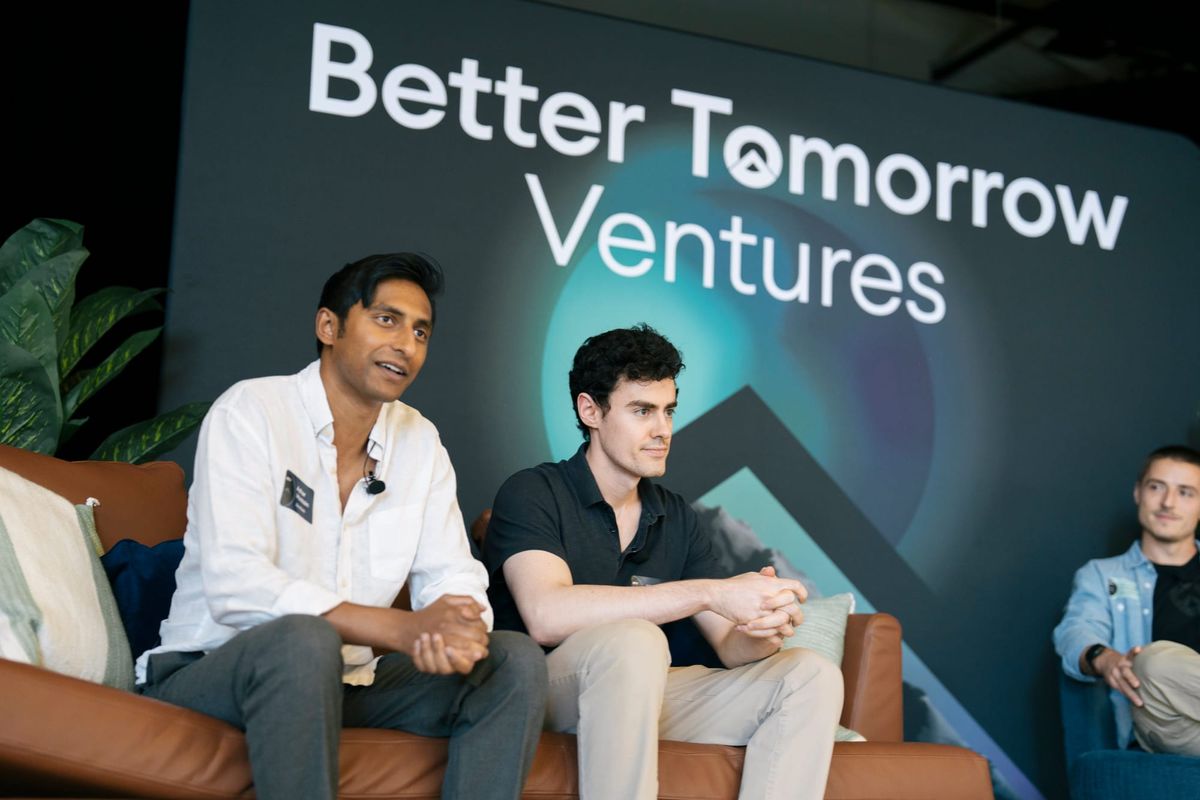
At our AGM, JC moderated a fireside chat with Elliot and Azhar, the Founders of Docshield. Transcript from the session copied below!
JC: Tell us about yourselves and the pre-Docshield story.
Elliot (CEO & Co-Founder): Hi everyone, I'm Elliot, the CEO and co-founder of Docshield. Azhar and I were roommates sophomore year of college and have been best friends since then. I started as an investment banker at JP Morgan focused on healthcare companies, then worked at TPG as a private equity investor, also focused on healthcare. I went to business school at HBS with the express mission of starting a company with Azhar. We had always kicked around ideas together in undergrad and figured, with the advent of LLMs, now was the time.
Azhar (CTO & Co-Founder): I'm a software engineer by training but started my career at Goldman Sachs covering fintech companies out of the investment bank. I left to join an early-stage fintech startup called Arcus as their first biz-ops hire and stayed through the acquisition by Mastercard. I then joined the Point72 Ventures team investing in early-stage fintech, and later left with a colleague to raise our own vehicle, which we invested over the last three years. As Elliot mentioned, it was time to get back to the operating side.
JC: What is Docshield? How are you building it, and what's the origin story of the problem?
Elliot: At its core, Docshield is an AI-native insurance brokerage focused on healthcare businesses. We make it faster and easier for them to buy the complex insurance policies they need to operate. As a broker, we sit between these businesses on one side and insurance carriers on the other.
We came at this from two angles. Both of us have doctors and practice managers in our families. Azhar's wife is a physician, and from the healthcare private-equity side you see that insurance costs are a top-three line item for physician practices. They buy multiple policies: property, cyber, and especially malpractice.
Malpractice is essential and very costly because a single patient claim can lead to a six- or seven-figure payout. In most of the U.S., on a per-physician basis, a surgeon's premium is going to be over $50,000 a year, and for an OB-GYN it's over $80,000 a year.
Despite the cost, the process is archaic and high-friction: around 15 pages of PDF paperwork plus a 5–10 page supplement for each doctor just to get quotes. We're building the first platform where you can apply in under 10 minutes for coverage for every doctor in a practice, lowering friction and making this line item much easier to manage.
JC: Why pursue a de novo, AI-native brokerage instead of rolling up existing brokers or selling software to them?
Elliot: On roll-ups, insurance brokerages are self-evidently high-quality businesses with recurring customers and very low churn, so they're expensive even when subscale. A $2 million EBITDA brokerage can still trade at a 10x+ multiple, which makes a roll-up strategy capital-inefficient. It's also hard enough to build a great product while doing heavy change management across a string of taped-together M&A acquisitions.
On selling software: development costs are trending toward zero, which pressures generic "wrappers." Insurance brokerages are also notoriously slow software adopters. The average midsize brokerage has about 0.5 IT employees and lives in a walled-garden AMS that's hard to integrate with. To build truly powerful tools, we need integration with our file storage, email system, and Slack, and we need to operate differently. Owning the brokerage lets us build the deeply integrated system that we actually use. We do have exceptional engineering talent: Azhar, and our engineer Tyler, who was a senior dev at Netflix and was interviewing with OpenAI when we hired him. But the model works best when we control the workflow end-to-end.
JC: How do you define "agentic," and how will humans and agents work together inside Docshield?
Azhar: Most traditional software engineering has been deterministic, which is reliable, repeatable, and the basis for battle-tested systems. Replacing all of that with a pure AI agent that orchestrates every workflow sacrifices those guarantees and leads to edge cases and issues like hallucinations.
Our approach is to keep deterministic scaffolding and insert purpose-built agents where legacy tools had gaps. In our industry those gaps fall into three buckets: document filing, document parsing, and document generation. Historically a producer had multiple account managers behind them doing this document busywork.
- For document filing, we built a taxonomy of insurance documents (COIs, binders, affidavits, policies, etc.) and an agent that classifies and routes them. Every carrier's documents look different, which makes deterministic rules brittle. With AI and training data, classification becomes tractable.
- For document parsing, AI converts unstructured documents into structured data at essentially zero marginal cost, which we can feed into deterministic workflows.
- For document generation, we can create five, ten, or fifteen proposals, quotes, or applications with one click, instead of humans transposing data across many forms.
On the interface, each generation of computing brings a new UX. AI enables a natural-language interface: text and talk. Our brokers don't need to live inside our internal system (Scaler). They can email our agents directly, for example, forwarding documents to documentfiler@docshield.com to auto-categorize and store them, or writing to quotes@docshield.com to get generated documents. The email client most producers already use becomes the interface.
JC: Why won't a horizontal foundation-model company just do what you're doing?
Azhar: Horizontal platforms keep expanding, for example, native document ingestion and large context windows, which squeezes generic middle-layer apps. The sustainable ends of the spectrum are the foundation models themselves and deep, vertical, workflow-specific software integrated with a customer's data and tools. Lawyers could "just use ChatGPT," but many prefer a purpose-built product like Harvey because it's tailored to their workflows and data. We're building that kind of vertical stack for insurance brokerages. We build software for ourselves first, and we sell distribution and customer relationships directly, which is more defensible over the next decade than selling generic software.
Elliot: There's also a market-size and priority reality. We're playing in a $50–100 billion market, which isn't small, but for a foundation-model company valued around $500 billion, even meaningful penetration may not move the needle. Choosing the right end-market and owning the customer relationship matters.
JC: Brokers win on trust and relationships. How will you build trust and win customers against incumbents?
Elliot: We think about this in two phases. Phase one is our wedge: medical malpractice. Traditional agencies dislike it because of the paperwork, and they set high minimum premiums, often $30,000 or $40,000 and up, because their cost to serve is high. As we continuously lower our cost to serve with automation, we can go after the neglected part of the market, such as a three-OB-GYN practice we won in Illinois with premiums just under $28,000.
We also believe human sales still matter. No one will put an $80,000 malpractice policy on a credit card without talking to a human. Our goal is to enable a 10x producer, a salesperson who can drive a couple million dollars of agency revenue per head without needing the three to five support staff that big brokerages wrap around their producers today. We can run a higher-margin business with AI-enabled producers.
Azhar: WWe deliberately started with malpractice because there was no digital quote flow. Most malpractice broker sites are "contact us" forms followed by a phone call days later. That messy, high-friction entry point gave us room to differentiate with a true digital intake. On our website a doctor can enter first name, last name, and state. We match against 1.1 million doctors and pre-populate about 80% of the application automatically. Pairing a better customer experience with internal AI efficiency gives us a clear reason to win.