Vertical AI Summit: The Economics of AI Growth
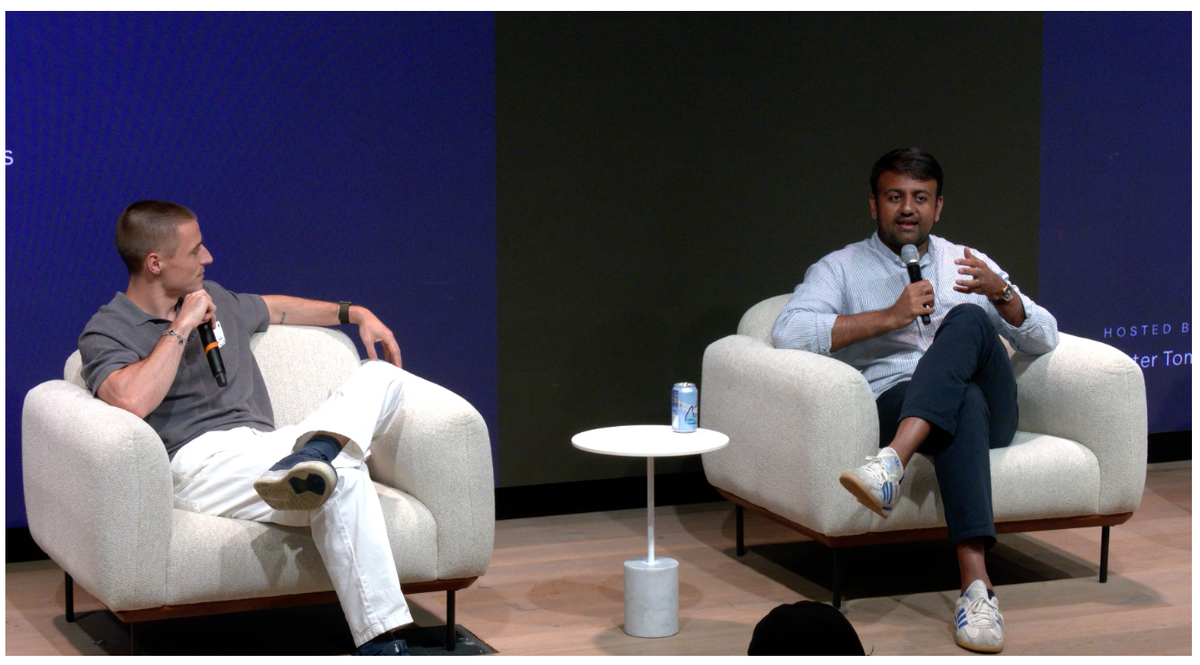
To close the inaugural Vertical AI Summit a few weeks ago, I moderated a panel on the economics of AI growth with Varun Anand of Clay and David Eckstein of Legora.

Varun is a co-founder of Clay, where he runs go-to-market. David is the CFO of Legora, the AI platform for legal work, who joined four months ago after three years as CFO of Vanta. Both companies went from $1M to $100M in run rate in under two years. They also agree on almost nothing, and told me so right before we walked on stage, which made it the most fun I've had moderating in a while.
My main takeaways:
- Control the controllables - you can't move the lab-level constraints you sit downstream of, so spend your energy on the levers you own.
- Reprice around value - pricing on tokens makes you a reseller of inference that gets commoditized as models get cheaper, so charge for the value you create.
- Finance is now proactive and a much more strategic function in the org.
- We are in an arms race, act accordingly.
Control the controllables.
I opened on an obvious vulnerability: neither of these companies controls the lab-level constraints they sit downstream of, the GPU supply, the usage-mix, and the demand swings that make up the cone of uncertainty Anthropic CFO Krishna Rao described on Invest Like the Best. The throughline from both Varun and David was the same. You can't move that cone, so spend your energy on the levers you own.
After I laid out the foundation for this part of the chat, Varun immediately disagreed and said the premise doesn't apply to Clay. For Clay, AI is just one component of a broader product, and Clay doesn't resell model usage at a markup. Customers bring their own API key, or use Clay's, and pay for the model directly, so the cost passes straight through. When a lab moves its prices, that lands on the customer's bill and leaves Clay's margins untouched. The one thing Clay actually has to watch is model encroachment: if Claude Code or Codex gets good enough that customers can build what Clay sells themselves.
David is more exposed, and his spot is more complicated. His biggest costs are the bills he pays Anthropic and OpenAI to run the product and he is competing with them at the same time, since the labs are moving deeper into legal. He controls what he can by owning the model decision himself. Legora does the cross-model selection for its customers, routing each task to whichever model is best for it, which lets him shift volume between providers as price and quality move. He spends more on Anthropic today but expects to send more and more to OpenAI over time. That control over the model layer is what keeps a price change or a model drop from dictating his gross-margin trajectory.
Reprice around value.
Clay ran a public pricing overhaul earlier this year, and Legora is living through the death of the billable hour. Varun's lesson: credits worked until they didn't. As he put it, cost-plus pricing is a can of LaCroix, where you charge for the aluminum and the can plus a margin and give away the part people actually want, the bubbles. Value-based pricing is a Ferrari, where the price reflects the experience you deliver. Pricing on tokens makes you a reseller of inference that re-commoditizes every time the model gets cheaper, so Clay now charges for "actions," the concrete units of value the product creates, and runs a 0% markup on the model itself. When Legora ran a marketing campaign around Ludvig Åberg (the Swedish pro golfer it sponsors), it used Clay to scrape the web and prospects' profiles to find the golf fans to target with direct mail and gifting, and each of those steps is an action Clay charges for.
Legora and the rest of the AI legal industry is switching to consumption-based billing, and within that, matter-based billing: their fidelity lets them say which lawyer worked on which project and charge it back, which helps move away from the billable hour. But David stressed that changing price in an industry like law, you need to think of it like building a bridge - you don't switch until the new bridge is built.
The CFO now sits on the front lines.
The old finance function was reactive: close the month and narrate how the game was played. David's version, what he calls the "first class of AI CFOs," is proactive. The new Finance function lives in the pricing of every enterprise deal, the choice of which model runs which workload, and the call on when a cost like document parsing turns unsustainable. He said "we're basically PMs running around the org."
The relevant metrics have changed too, things like gross margin per customer and the cost of switching models. When COGS is a live variable you steer every week, your finance hires looks nothing like the one you'd have made two years ago. This is something Varun talked about as well - he brought in Karan, Clay’s Head of Finance, as a deliberately strategic finance hire, someone he valued for making every decision across the company sharper, which is why data science, pricing, and a lot of legal all run through him.
We are in an arms race, act accordingly.
We talked about how the old software playbook was spend-to-grow because marginal cost goes to zero, but is AI different? As things stand, it seems like every dollar of revenue drags a dollar of cost?
In some ways nothing has changed. This is the same land grab the last cycle ran, the one Uber and Lyft burned billions to win. Varun's framing on when that playbook works: margins "can be a mirage," and if you aren't genuinely confident in the value you create and charge for, you end up like MoviePass, where the day you raise prices, nobody shows up. So are you the Uber that can fix it later, or the MoviePass that can't?
David is betting Legora is Uber and can back it up: a burn ratio under one, two-to-three-times reductions in cost per task, buying higher-margin businesses, and taking control of his own inputs like US case law. In a land grab, Legora needs to act accordingly. With net revenue retention above 500%, gross retention near 99%, and roughly a trillion dollars of legal work moving from firms into software, the customer you win now is the customer you keep. So you go land them now, even at a near-term margin hit, before a competitor or a model gets there.

Thanks to Varun and David, who were generous, candid, and a lot more fun than a panel on economics has any right to be.