Will Vertical AI Survive?

In the past 3 weeks, Anthropic in particular has been on an absolute tear. Claude Code, Cowork, Claude for Excel and Claude for legal review have left the market asking questions of the entire Saas industry and the emerging Vertical AI ecosystem at large.
The current consensus view is saas is dead...presuming that's right, the next interesting next question is
— Jack Altman (@jaltma) February 6, 2026
What companies are "safe from ai"?
- handling money, regulation
- agents on top of company data
- most hardware?
- maybe systems of record?
- security?
- marketplaces?
Vertical AI was supposed to be the application-layer opportunity for VC funds raising this cycle. Leverage foundation models, entrench yourself deeply into a vertical, build agents to coordinate hairy longtail workflows and hopefully build a defensible product and business. But foundation model companies know that verticalization drives diffusion, adoption, and revenue so now they are verticalizing and they're doing it fast. Should Vertical AI companies be worried? Of course, but not all of them equally.
I think the Vertical AI companies that can compete are those that own what I call the last mile of AI, delivering intelligence for a specific outcome in a specific context with specific accountability. This means:
- Coordinating intelligence and outcomes with real world liability, administrative and regulatory endpoints.
- Managing relationships with authorities, auditors, and real world systems
- Handling exceptions and edge cases that models cannot anticipate
- Delivering outcomes transcending both the digital and real world
Last mile defensibility is a spectrum
I think of last mile coordination on a spectrum of short to long. Short is more susceptible to foundation model creep and long is less so. Naturally, the last mile is not equally long in every domain. Some domains are more exposed than others. Here’s a quick mental framing:
Shortest last mile: Marketing copy, image generation, content drafting. These are transactional output businesses. Foundation models will absorb them if they haven't already. See $FIG for reference.
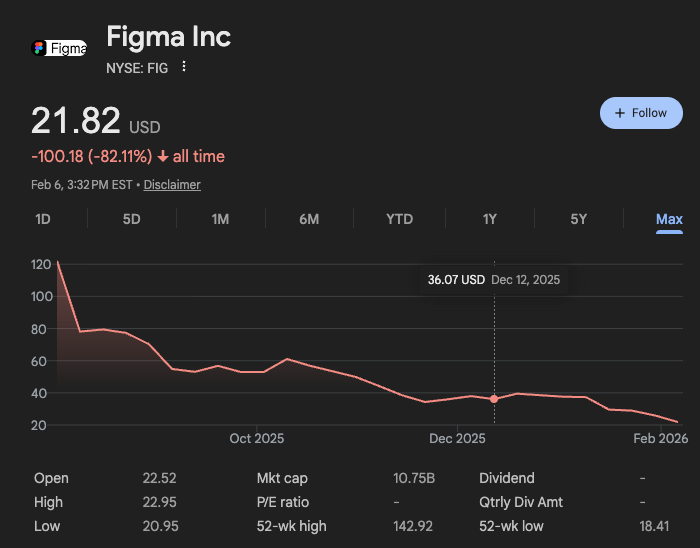
Short: Coding assistants, basic legal drafting, research copilot. Useful, but thin. Claude and OpenAI are already here.
Medium: Contract analysis, financial modeling, internal workflow automation. We are beginning to see Claude, OpenAI and Gemini stake their flags here. Vertical AI companies such as Rogo, Harvey and Hebbia have wedges that start here but must quickly move into the long last mile if they haven't already.
Long: Tax compliance with filing, audit-ready accounting, licensed professional services, cross-border regulatory coordination, healthcare with FDA and HIPAA requirements, anything that requires coordination with real world systems. These have structural defensibility.
One clear outcome of the AI trade is that while some SaaS companies get hit hard, operationally heavy ones like $OPEN and $DASH will disproportionately benefit from this.
— Jon Chu // Khosla Ventures (@jonchu) February 6, 2026
Anyone else have other ideas on where the interesting trades are? Regulatory capture ala PLTR?
Most companies do not start at the long last mile, they wedge in at medium and push toward long over time. But as foundation models verticalize faster, the window to make that move is compressing. The wedge you choose needs enough real world coordination to survive long enough to expand.
Also last mile delivery is not solely dependent on the vertical. It's dependent on the vertical and the product choices that a team makes to deliver an outcome to their customer. Within a vertical, there might be multiple companies that promise differing outcomes. Differing outcomes are consequences of product choices and last mile complexity ergo defensibility.
Product choice significantly determines last mile coordination complexity. A mental framing below:
Consider the difference:
- Legal AI as a tool for lawyers (short last mile) vs. AI native legal service owning malpractice (long)
- Tax software where the user calculates and signs off (short) vs. tax service that calculates, files and faces audits (long)
- Accounting AI for accountants (short) vs. platform owning audit trail and ensuring compliance (long)
Three questions determine your position:
- Who is the principal? Are you a tool for someone else, or the entity responsible for the outcome?
- Who owns the liability? When something goes wrong, whose problem is it?
- Who holds the relationship? With regulators, auditors, authorities, who do they call?
If the answer to all three is "you," you have a long last mile. If the answer is "your customer," foundation model creep can be a serious threat.
The things that make long last mile coordination hard i.e. liability, regulatory complexity, real world accountability are exactly what make it valuable. Liability in particular sounds like risk, but for Vertical AI I think it becomes leverage.
Embracing liability is more than a moat
For Vertical AI, entrenching deep within a vertical and coordinating across the long tail of systems to guarantee outcomes on behalf of the customer is a defensive moat against foundation model creep. Absorbing liability in case something does not work as it should is more than just defensive, I think it's strategically superior. It's complete ownership and accountability, the longest form of last mile coordination.
Pricing Power
When you compete on outcomes, you're measured on pricing and results. When you own liability, you outcompete on trust.
Owning liability converts cost center pricing into insurance pricing. Customers are not paying for software anymore, they are paying for certainty. As an example, tax calculation software is a commodity. The tax compliance platform that files accurately and faces audits on your behalf is worth a premium.
Barriers That Compound
AI has eroded feature scope as a competitive barrier to entry but I think last mile barriers work differently. They compound:
- Every successful audit faced strengthens regulatory credibility
- Every edge case handled adds institutional knowledge
- Every year of compliance history deepens dependency
- Every jurisdiction mastered raises the bar for competitors
(Talking my own book here but this is why I think fintech in the AI era resonates resonates more than ever)
Fintech is perhaps best positioned in this SaaS sell-off narrative
— Seth Rosenberg (@SethGRosenberg) February 5, 2026
You can't vibe code:
1. Brand/trust
2. Distribution
3. Regulatory licenses
4. Capital markets relationships
5. Underwriting data
etc.@Wealthsimple @Revolut https://t.co/YR1GViT6hv @get_aspora
The public markets have decided that SaaS revenue durability and growth is challenged at best and extinct at worst.
— Harry Stebbings (@HarryStebbings) February 6, 2026
So where is value in a world of uncertainty.
Gnarly, f****** hard, backend businesses.
Fintech for one.
Airwallex and @awxjack the level of integrations,…
Owning Liability != Services Business
I think a misconception is that long last mile businesses, especially those that own liability, are services businesses where humans step in to close the gap when AI cannot fulfill the outcome promised.
I disagree, owning liability is not restricted to confidently handling edge cases. Owning liability can be:
- A consequence of unique insight and coordination of software and agents with real world systems in a manner that others have not discovered yet. Outpost handles cross-border tax compliance for merchants. They don't just calculate taxes, they coordinate filings across the world, face audits, and own the entire tax liability on behalf of their customers. A few others to follow here are Docshield who operates as an AI native full stack insurance broker and Layer an embedded full stack accounting provider to SMBs who run their businesses on digital platforms.
We built Outpost to let AI companies scale without the compliance headache.
— 👨🏻💻🚀 (@Willmahonheap) November 24, 2025
Hit our APIs, and we become liable for your VAT, GST, and Sales Tax.
Never think about tax again. https://t.co/wrrMNIe9aS
will@outpostnow.com https://t.co/7W4le8nY0c
- A consequence of superior technical choices that allow the product to take on more scope and be more assured. Monk manages complex billing and revenue across various contract types, and their agents can reason through edge cases and handle customer interactions with empathy, technical depth that lets them own outcomes others shy away from. Another to follow here is InScope who similarly must coordinate across company general ledgers, billing systems and external disclosure and audit endpoints.
some optimize for flexibility/abstractions. we optimize for duplication first
— George Kurdin (@GeorgeKurdin) January 27, 2026
our POV is that the wrong abstraction early, especially in our domain (AR), is strong -EV
fast read from the team @usemonk on how we think through abstractions vs duplication
props to some of our fav… pic.twitter.com/4hIz5Iis2V
- A consequence of deep entrenchment within a customer not only for technical implementation but also to steward behavioral and workflow change within the customer. Basis builds AI workers for accounting firms but adoption requires training accountants to trust and use AI workflows, owning the audit trail, and embedding deeply into how firms operate everyday. A few others to follow here are Rely who works with real estate underwriting/transaction teams and Blaise who works with insurance carriers and their regulatory filing teams.
Every time we automate a manual process, we create space to think and ask better questions. That's what today's hackathon with @trybasis is about – equipping our team with AI agents that understand our workflows, so they can focus on the work that actually matters to clients. pic.twitter.com/6Czi2wFKjs
— Wiss (@wissllp) October 22, 2025
Wrapping up
Foundation model verticalization is real and accelerating leaving Vertical AI companies with short to medium last mile coordination exposed, this much is clear. However, the defensibility of Vertical AI's last mile is preserved when outcomes necessitate coordination with real world systems and when companies absorb the associated liability.
In this context, the product approach is more critical than the specific vertical itself. Tools for professionals are vulnerable, but companies who own the outcome are not. Owning this last mile and the defensibility it provides also creates compounding pricing power and barriers over time.
Ultimately, for the most successful Vertical AI companies, value will accrue to those who master the last mile, the complex coordination between AI and the real world.