On Risk

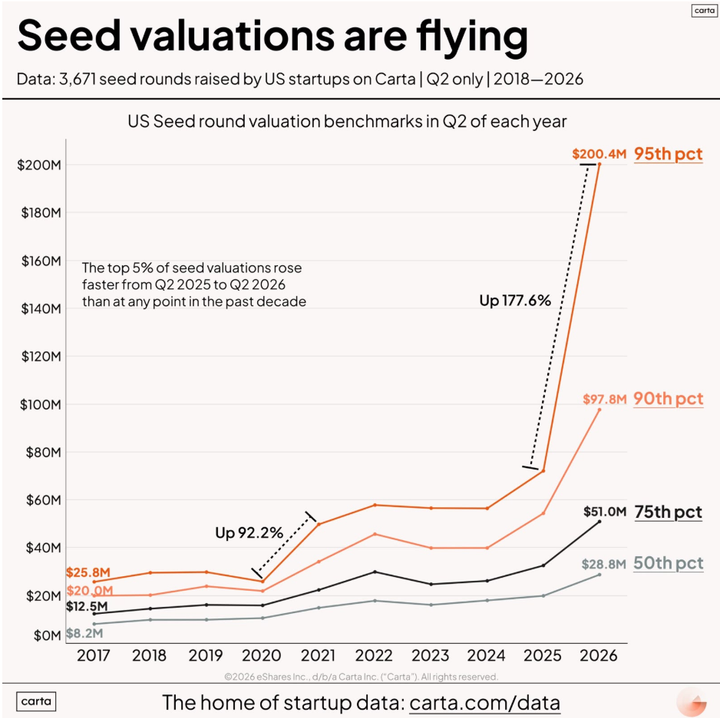
TINA has overtaken the venture market. There is no alternative. As long as the music is playing, you've got to keep dancing. You've got to play the game on the field. If a founder isn’t raising a $10m seed round, they're not ambitious enough.
I've heard some version of all of these in the last month, as justification for someone raising a bigger fund, writing a bigger check, paying a higher price.
The evolution of venture is starting to look a lot like the evolution of the public markets: everyone owns the same handful of names, everyone is benchmarked against everyone else, closet indexing is on the rise, and the safest thing you can do for your career is increasingly the riskiest thing you can do with your LPs' money.
Fewer investors, fewer companies
More and more capital is being concentrated in the hands of fewer and fewer investors, who are then concentrating that capital into fewer and fewer companies.
The numbers are kind of wild:
- Established firms have taken 88.2% of all US venture capital raised so far in 2026, the highest share PitchBook has ever recorded. Andreessen Horowitz alone has closed $23.8B, more than 20% of everything raised this year.
- In the first half of the year, three firms (a16z, Thrive and Founders Fund) took in 48.1% of all capital raised.
- Funds over $1B now capture about 68% of dollars raised. Funds under $50M are two-thirds of all funds by count, and about 4% of the capital.
- First-time fund formation is on pace for its lowest year since 2016.
And on the deployment side it's the same story. Mega deals of $100M or more captured 87.5% of the $412.7B deployed in the first half of 2026, and AI was 86% of all venture dollars. Of the $274B in venture-growth capital deployed through May, 86% came from four rounds into three foundation model companies. As Dan Gray at Odin pointed out this week, 2026 has already seen 44% more capital deployed than all of 2021, and yet small rounds keep shrinking, not just as a share of deals but in absolute dollars. In 2016, rounds under $50M were more than half of all capital deployed.
There's more money than ever. It's just going to fewer places.
The aperture is as narrow as it's ever been
The result is that the aperture for what's viewed as venture-fundable is as narrow as I've ever seen it.
This is the opposite of the last bubble. In 2021, money was flowing freely, the graduation rate for companies basically approached 100%, and every shitty company was getting funded.
Now, even high-quality companies can't get funded unless they check exactly the right boxes: the right category, the right pedigree, the right logos on the cap table, the right topline growth chart, the right AI narrative.
If you're capital-efficient, and growing 3-3-2-2-2 with great unit economics, that's a fine, durable business that a lot of firms will politely tell you is "not venture scale" right now. You should maybe consider pivoting into selling non-existent robots and bleeding $1b/yr, so you can raise from anyone you want.
Closet indexing comes to venture
There's a parallel here to the public markets. Long/short equity funds get compared against each other by LPs and by the market, so they all end up investing in the same things and effectively tracking the overall index. If you don't own the top five performers in the index when you file your 13F, your investment committee and your LPs start asking questions. If you're not levered long the themes the consensus has agreed are the right themes, you're just tying your own noose.
That's happening in venture now. The maturation of growth investing has pushed incentives, and investment strategies, to look more and more like that.
And it flows all the way downstream. If all the large Sand Hill funds are investing in the same things along the same metrics, everyone downstream keys off of them. If those funds aren't chasing heat on something, nobody else wants to touch it. If you're an earlier-stage investor, your whole strategy becomes: how do I find the things that will have that same heat one round later, so those funds will back them?
The whole game becomes trading, and learning how to pass the bag to the next guy, rather than investing and building.
Which ultimately means we've strayed pretty far from the light as far as venture investing is concerned. In this world, who finds the non-consensus ideas and the weirdos? Who supports the founders that haven’t earned the credentials, yet? What’s the pipeline for the world-changing or life-saving companies that might only be worth billions, and not trillions?
Trading career risk for financial risk
Keynes said it almost 90 years ago: worldly wisdom teaches that it's better for reputation to fail conventionally than to succeed unconventionally.
That's the trade most of the market is making right now. People are investing in things that are viewed as safe in order to protect themselves and look smart. Nobody ever got fired for co-investing with Sequoia. If you're an earlier-stage investor you want to back the same companies, the same founders and the same themes that you think Andreessen, General Catalyst and Lightspeed are going to be clamoring over one round later. And so you follow the credentialism all the way down - name brand LPs backing name brand VCs who only back ex-OpenAI, ex-Stripe, YC, Stanford.
But that means the valuations on those companies are absurd. Anything that has heat, or might have heat, or clears the credential hurdles, is worth whatever you have to pay to get it done. So you're taking on a lot of financial risk to mitigate your career risk. Just like in the public markets: you have to own the top stocks, so everyone pushes them up, and then you have to keep buying no matter how expensive they get.
You can even see the consensus on full display in the way founders now pitch their companies. If the bar for a Series A is a specific growth curve, founders will find a way to produce that curve. We're seeing a lot of what people have started calling "vibe revenue": two-week pilots annualized into ARR, contracts with 90-day opt-outs counted as recurring (11x got caught doing exactly this), one strong month multiplied by twelve.
And curiosity revenue being treated as gospel. So many of these “AI startups” are essentially consultancies whose entire product strategy is to send in FDEs and hope they can develop an actual product strategy, then the startup takes those "if we build this, you might pay us up to $10M in usage over time" engagements and books them as $10M of revenue today. Then a product never materializes, or never hits its mark, everyone churns, and the revenue is never realized. Some of the companies re-selling tokens today look a lot like the companies selling eyeballs 25 years ago. As an aside, Pets.com went from IPO to liquidation in about nine months.
So what now?
I don't think this lasts forever. Do I think that the technology landscape has permanently changed, and huge durable businesses are going to be built? Yes. Do I think the market is going to over-extrapolate and do the same thing it always does? Also yes.
Markets talk themselves into this every few years and then talk themselves out of it. You just can't know how long it lasts or what it looks like on the other side. Another Keynesianism is “markets can remain irrational longer than you can stay solvent.” But then we’ve learned time and time again that when things do break, and they always do, they do it in sudden and unpredictable fashion (a virus, a war, a sovereign default, a “too big to fail” bank failing) that wipes out anyone too slow for the exit.
So what can we do? Our job is to make money in bull markets and bear markets. To ride the waves up, but also to not drown when the waves break.
That means focusing on the things that won’t change. And being patient at a time when patience is the world’s most scarce resource.