What We're Thinking About (Excerpt from BTV LP Update)
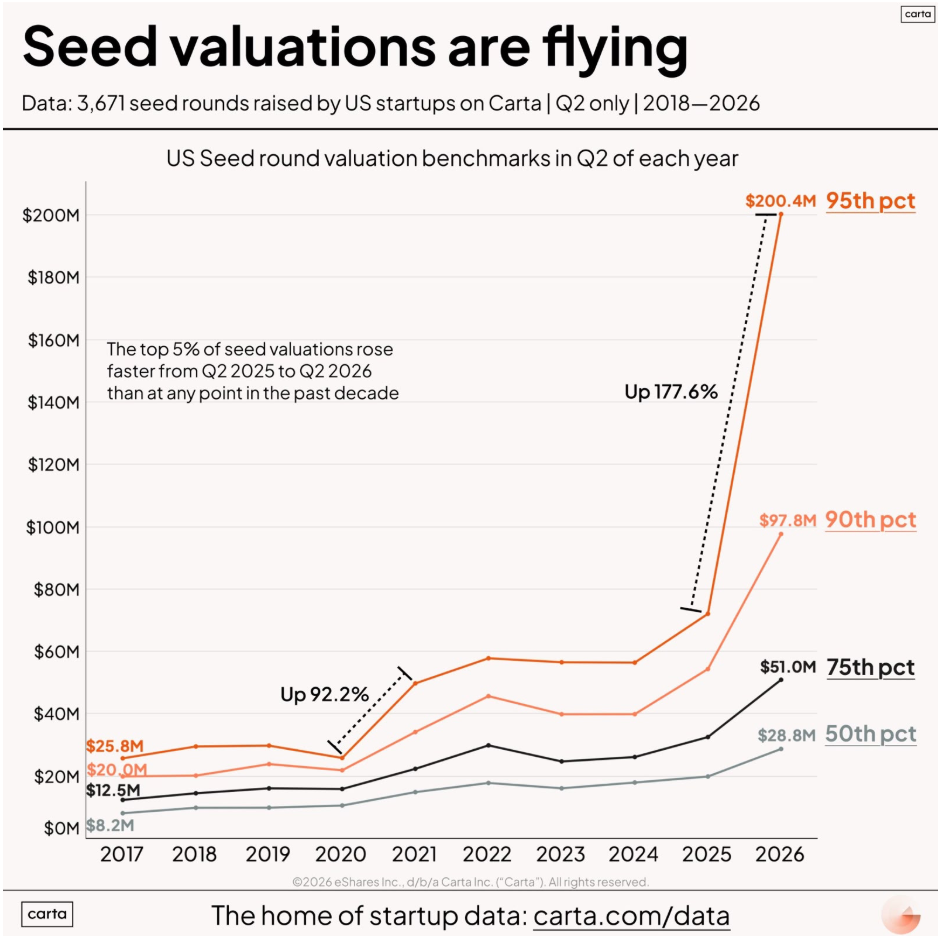
Seed valuations are flying. Per Carta, the top 5% of seed rounds are now getting done at $200m+, up 177% in a single year, and the median is around $24m. What we have spent many years calling seed is now labeled pre-seed, and what's now labeled seed often carries a Series A price with a seed product and traction.
Nihar wrote about a related delusion recently: the belief that "up and to the right" can be manufactured, picked off the shelf, or financed into existence. Since this is the debate happening in our team WhatsApp group chat every week, we figured we'd share where we're netting out.
"Paying up" keeps getting conflated with conviction. Feeling really good about a team doesn't make the outcome bigger and it doesn't make the company more likely to succeed. Conviction tells you whether to invest while price determines what you make when you're right. In markets like this one, those two ideas get blended together, and that blend is how you end up paying growth prices for seed risk. A reopening IPO window helps everyone, but a better exit market doesn't make a 2x entry price a 2x outcome.
In an environment like this, the locally rational move is to be levered long everything. It's impossible to know when things change, and until they do, FOMO and YOLO get rewarded. But when they do change, being levered long is what kills you. And the last few years have raised a frustrating question: does it even matter if you get wiped out on the way down? We've watched firms do all the stupid things on the run-up, take it on the chin, and keep writing checks anyway. Leopold Aschenbrenner's Situational Awareness lost roughly $35bn in a month when its leveraged AI bets unwound, and was writing a $400m private check days later. Maybe that moral hazard persists forever but we're not willing to bet BTV on it.
So we're largely staying where we've always lived: targeting small, first-money-in rounds reserved for experimentation, with a heavy focus on the people, and a healthy skepticism to flippant "this is a $100bn opportunity" narratives. That's been the game across three funds.
That said, there are of course companies we will pay up for. If we believe there's potential for a generational outcome, and there's a structural advantage underneath it, we'll stretch. For us that usually means a company that owns the outcome instead of selling a tool: it carries the liability, holds the regulatory relationships, and handles the complex coordination with real-world systems that foundation models won't take on. Nihar has written about this as last mile defensibility and those are the types of moats and structural advantages that tend to deepen as intelligence gets cheaper. A proprietary data advantage that gets locked up early and compounds can qualify too. The bar is just much higher, and we have to be honest with ourselves about whether we're applying that bar or rationalizing a hot deal.
We never want to lose the founder bet. Some of our best investments were decided in days on the strength of one exceptional person (or a few), and we want to keep enough slack in our process and system to always be able to make that happen. But once a founder bet is priced above a certain threshold, we owe it to ourselves (and to our LPs) to really pressure test the business model and market opportunity too.
And then there's category creation. Most AI-native companies of the 2023-2026 vintage look like vertical SaaS rebuilt for an agent-centric world. But we think the next five years will bring a wave of genuinely new categories, companies that don't map to anything on the existing software shelf. Those are harder to underwrite, especially at today's prices. Our job is to be ready for them, which means embracing weird and funky ideas again and accepting that the occasional misunderstood but massive vision deserves a healthy chunk of our time even (or maybe especially) when there's no comp to point at.
In the meantime, we'll watch others pay prices we won't for consensus $100bn visions, and some of those will end up working, which will sting. But we view our job as making sure that we catch those from that cohort who actually fit our bar, before they become consensus, and that we are appropriately compensated for the risk.
We've been wrong as often as we've been right on market timing, so we won't pretend to know which way sentiment breaks from here. Good luck to us all!